Friday, September 16, 2011

Randy Gener's essay on state of U.S. theater published in "The World of Theatre" editions in Bangladesh and Paris, with book launch in China

XIAMEN, CHINA; DHAKA, BANGLADESH; and PARIS, FRANCE:  The Paris-based International Theatre Institute (ITI) – the world's largest organization for the performing arts – is holding its 33rd world congress at the Xiamen International Conference and Exhibition Centre in Xiamen, China, from Sept. 19 to 24, 2011.  Held under the auspices of UNESCO, the congress will have a strong education and artistic focus, as well as offer a sumptuous showcase of xiqu, the generic term for Chinese music theatre.

The French edition, edited by Nicole LeClerq
On this occasion, ITI will celebrate the book launch of the newest edition of The World of Theatre, an account of the world's theatre seasons 2007-2008 and 2008-2009, for which I contributed a critical essay that sums up and evaluates the state of U.S. theatre from coast to coast.  The period which my essay considers coincides with dramatic unraveling of the Aught Decade, which resulted in a worldwide economic recession, and a political transition that brought about the rise of an African-American as the 44th president of the United States.

The 2011 edition of The World of Theatre is a major biennial ITI publication that contains articles by ITI national centers and provides a vast panorama of theatre productions and recent developments in each country over the past two theater season.  The U.S. Center of the ITI invited me to publish an essay on USA theater, summarizing the 2007-2010 seasons.

Ramendu Majumdar
The book will be published in English, French and Arabic languages.  Published for the ITI by the Bangladesh Centre of ITI, the English edition of The World of Theatre is edited by Ramendu Majumdar and Mofidul Hoque. (For orders contact: ITI General Secretariat at info@iti-worldwide.org or +33 (0)1 45 68 48 80. The cost is 20€.)  A leading figure of Bangladesh theatre, Ramendu Majumdar is the general secretary of the Bangladesh Center of the ITI and is its current president. He is also vice president of ITI (Worldwide).

The French edition, Le Monde du Théâtre, is edited by Nicole Leclerq.  A collaboration by Laurence Pieropan and Laurent Rossion, the French version is available through Peter Lang Editions (ISBN 978-90-5201-729-7 br., www.peterlang.com) at a cost of 39.50€.

Here are the opening words of my essay on the state of U.S. theatre in The World of Theatre:
We had had enough.  We had endured eight years of a lame-brained president.  We were worse off then than we were after the rubble of the 9/11 attacks had cleared.  Our country, both domestically and abroad, took such pounding, so many hard body blows, that our minds reeled at the question:  How could the first years of the 21st century have come to such naught?
Intriguingly, the two theatrical seasons in consideration here coincided with two extraordinary events in U.S. history.  The 2007–08 and 2008–09 seasons marked the dramatic unraveling of the so-called Aught Decade, which resulted in a worldwide economic recession.  Those two seasons, moreover, spanned a major political transition in the White House that began with a closely fought contest for a viable Democratic candidate, set off an intense and wrenching reevaluation of core American values, then concluded with the rise of a seemingly mesmerizing and path-breaking African American as our country’s 44th president.
The so-called Nought Decade—or the Noughties (to borrow a theatre critic’s 1904 appellation for the “00s” of the previous century)—left the vast majority of Americans weary and worried, feeling bruised and disillusioned.  With a right-wing president at the helm, our list of grievances were large and embarrassing: fighting two wars in the Middle East that dragged on and couldn’t be won, two financial meltdowns at each end of the decade, a free-market economy that slid from happy-go-lucky to the brink of collapse, a wave of Wall Street frauds highlighted by Enron and WorldCom, the cardiac arrest of the newspaper and book publishing industries while the bumper-crop promise of new media failing to legitimately catch on, an endless proliferation of political sex scandals, the self-destruction of Detroit’s automobile industry, a housing-industry bubble that got double-whammied by the shrinkage of household income and excessive borrowing, the alarming rise of unemployment, plus (don’t hold your breath) grave environmental problems sparking scientific calls-for-action and public concern that for complex reasons did not inspire world leaders to work together and craft a workable global strategy of green living and ecological protection.
It was a sordid decade. Looking back, Time magazine shrieked, “The Decade from Hell.” In the theater, we openly asked, “Have we entered a new Depression not seen since the Great One of the 1930s?”  Exact statistics for 2009 might not have been available as of this writing, and so the full impact of the economic recession will not be completely known until perhaps in late 2010, and yet there was no question that the economic recession took a devastating toll on the nation’s arts and culture industry, especially symphony orchestras, museums (many of which faced auction blocks and closures), and nonprofit theatres (a species that is historically undercapitalized and financially vulnerable).  Particularly in the states of Wisconsin, Idaho, Illinois, Minneapolis and Massachusetts, many small- and midsized theatre companies across the country laid off their employees, eliminated educational and audience-development programs, cut short their seasons, ceased operations entirely, or, facing severe cash crunches, embarked on emergency measures (such as “Save Our Theaters” campaigns using Facebook, MySpace and other social-networking media) to cover production expenses and pay critical debts.
A majority of larger nonprofit theatres, by nature of the annual season subscriptions being sold in advance to audience members, narrowly staved off financial hardship during the 2008–2009 season and began to brace for the full brunt of the economic downturn to potentially hit during the 2009–2010 season.  Although Broadway remained as star-studded as ever (partly due to a Local One stagehand strike in the fall of 2007, the first one in the union’s history, which pushed back preparations for Broadway openings, as well as a Writers Guild of America strike in November 2007, which hit mainly the movie and TV industries—both of which freed some famous names to pursue stage work), by January 2009 an unprecedented number of commercial productions (Hairspray, Young Frankenstein, Boeing-Boeing, 13, Grease, Spamalot, Gypsy and Spring Awakening), many of which had had long runs, immediately shuttered.  A couple of Broadway favorites (the satirical puppet musical Avenue Q and the Alfred Hitchcock whodunit The 39 Steps) downsized and decamped to smaller, less expensive digs.  Such Off-Broadway-to-Broadway transfers in the same season have not been seen in the commercial theatre since at least the early 1980s. 
Criticism and arts journalism were dealt with the severest blow.  In many cities, including Denver, Los Angeles and San Francisco, newspaper cutbacks and closures resulted in painful job losses, layoffs and buyouts of arts critics and reporters.  Chain owners of the Philadelphia Inquirer, Chicago Tribune and Los Angeles Times filed for bankruptcy; the Seattle Post-Intelligencer went online-only, while the Christian Science Monitor and Detroit Free Press started printing fewer editions and morphed their content into cyberspace; the New York Times, Boston Globe and San Francisco Chronicle went through several rounds of staff reductions and deep cost-cutting.  A triumvirate of artistic leaders in California published a letter to their hometown paper, the Los Angeles Times, decrying the elimination of critical voices and defending the importance of public critics in the civic and cultural life of the city.  “If we let these voices slowly and quietly disappear, the consequences are simple and inevitable,” the letter stated.  “Fewer people will know about the productions, fewer people will purchase tickets, and, eventually, fewer theatres will exist.” 
The performing arts had gotten shafted—stuck with the lousy end of the stick.  After 20 years of the Bushes and the Clintons, angry American voters wanted sweeping change with Obama—the promise of a break with the unhappy past or of a new style of politics or, perhaps, a novel racial transcendence.  But exactly what kind of change could be realized after the November 2008 presidential elections? 

Why hold an ITI world congress in China?
According to an ITI press release, this is the first time an ITI world congress takes place in China, and the choice of Xiamen as host city was no accident. Xiamen, China's main port in the 19th century for exporting tea, was also one of the original Special Economic Zones set up in 1980 to attract foreign investment.

In September, this historically international city, aspiring to become a cultural destination of world renown, already committed to music theatre and dance, will shine the spotlight on the larger field of the performing arts, opening its doors to over 300 congress delegates from 70 countries, including a 92-year old renowned actor from Romania, as well as 500 participants from different parts of China.

The congress will be formally declared open by Zhao Shi, general secretary of China Federation of Literary and Art Circle, and Ramendu Majumdar, president of ITI Worldwide, in the presence of the mayor of Xiamen city, the director of the Art Department of the Ministry of Culture and prominent Chinese leaders.

Among the delegates journeying to Xiamen from afar is Sheikh Sultan Al Qasimi, the ruler of Sharjah and member of the Supreme Council of the United Arab Emirates, who will be receiving an ITI Medal for his outstanding contribution to the global performing arts sector as the main benefactor of ITI. This prestigious medal is awarded to exceptional artists and patrons of the arts to recognise the critical role they play in shaping the international performing arts scene through their creativity, generosity and vision.

Tobias Biancone
Says Tobias Biancone, director general of ITI General Secretariat, “As a non-governmental organization with centers and cooperating members in more than 100 countries, ITI has a vast network of performing arts practitioners. However, many of them from developing countries, especially in Africa and South America, are struggling for survival. It is only through the deep generosity of supporters like Sheikh Sultan Al Qasimi, that we are able to ensure that less fortunate nations do not end up being under-represented at significant events like the world congress."

In addition veteran Chinese artiste, Shang Changrong, will be honored as the new World Theatre Ambassador of ITI.

The theme of this congress is “Empowering the performing arts: A journey to xiqu,” a term often erroneously equated only with Beijing Opera. In fact, Beijing Opera is but one of xiqu’s over 300 forms, which the journey to Xiamen aims to showcase to the international delegates. Reflecting on this theme of strengthening the performing arts by increasing awareness and raising public support on a larger scale, ITI is intent on using the congress to challenge preconceptions and better acquaint performing artists and aficionados around the world with the full spectrum of the organization’s work, goals and aspirations.

ITI will also be taking the opportunity to invite representatives from the respective Ministries of Arts Culture in neighbouring countries with a view to opening new centres in the region, and engaging them in a discussion on how to strengthen performing arts training and exchanges regionally and globally.

The International Theatre Institute ITI was founded in 1948 by theatre and dance experts and UNESCO. The NGO advances UNESCO’s goals of mutual understanding and peace and advocates the protection and promotion of cultural expressions, regardless of age, gender, creed or ethnicity. It works to these ends internationally and nationally in the areas of arts education, international exchange and collaboration, and youth training.

Since 2008, the ITI has been undergoing a rigorous process of modernization, revitalising the organization and reclaiming its role as the most important international performing arts network. It has attracted new members ranging from Puerto Rico to Qatar and Australia, and launched new initiatives including the ITI World Member Card.

Logo of ITI
For more information on ITI, please visit the ITI website: www.iti-worldwide.org.

For more information on the congress, please refer to the ITI World Congress website: www.iti-congress.org.

Tuesday, August 23, 2011

Randy Gener Lectures in the U.S., Asia and Europe

In the past year and a half, I have had the pleasure to speak and lecture on a number of subjects in Asia, Europe and the United States.  Frequently I am invited to speak as a panelist or moderator of a panel discussion.  I have helped organize and moderate conferences, symposiums and world congresses.  In one case, I was the featured guest on an hour-long televised cable show.

The themes run the gamut. I have addressed issues and controversies relating U.S. arts and culture. I've lectured on American musicals in an international festival of European operetta.  I've tackled new currents in theater and democracy in the international sphere. A favorite speech of mine concerns the impact of new technology on narrative design. I've given workshops on writing and criticism.  I presented a proposal at a governmental working session and gathering whose purpose was to suggest to the Philippine government ways by which arts and culture can respond to issues of migration and development.

The gig I have always found most satisfying is to give a multimedia lecture on a theme, such as "Secret History of the American Theater" or "Storytelling By Digital Design" (lectures I have frequently given), because this format allows me to sustain and develop the ideas to what frequently amounts as a study course in itself, and the interaction with the audiences tend to be intimate and intense.  

Being interviewed by ABS-CBN reporter at the Nathan Awards ceremony
Whether live or on television, speaking is very much worth it, because it is part of sharing knowledge and expertise.  The venues that have invited me typically break down to three types:
  • Colleges and universities:
    • Martin E. Segal Theatre Center-Graduate Center, CUNY
    • City University of New York
    • Montclair State University
    • University of South Carolina 
    • Brooklyn College;
  • International festivals and arts events in Asia, Europe and the U.S.:
    • Sibiu International Theatre Festival
    • Extraordinary Congress of the IATC in Seoul, South Korea
    • Prague Quadrennial
    • William Inge Theatre Festival
    • Humana Festival of New American Plays
    • New York International Fringe Festival;
  • U.S. corporations, U.S. nonprofit institutions, and foreign cultural institutes:
    • Nuyorican Poets Cafe
    • Hallmark Inc.
    • Dramatists Guild of America
    • New Dramatists
    • Odeon Theatre of Bucharest
    • Romanian Cultural Institute-New York
    • Long Wharf Theatre Company
    • Pan Asian Repertory Theatre
    • The Public Theater
    • La MaMa E.T.C.
    • UNITER, the Romanian Writers Union.
In the interest of summing up an extraordinary year, I've listed below my itinerary of talks from 2010 to 2011.  The schedule, presented in reverse chronological order, starts with the daily gallery talks in Prague and looks back to a memorable trip to India, where I moderated a discussion that was simultaneously translated to me, because half of the papers were delivered in a number of regional Indian languages. (I still keep in contact with the Gujarati people I've met in India and hope to visit them again someday.)  I also listed any press coverage each speaking engagement might have generated. 

If you are interested in engaging me in a lecture, a panel discussion or a presentation, please don't hesitate to contact me.


RECENT SPEAKING ENGAGEMENTS


--> Prague Quadrennial of Performance Design and Space / Prague National Gallery Talks: "From the Edge," the USITT-USA National Exhibition
June 2011 / USITT, Arts Institute-Theatre Institute of Czech Republic, and Veletzrini Palace / Prague, Czech Republic

Nancy Keystone, Justin Townsend and Randy Gener give a gallery talk at USA national pavilion in Prague
Host, Moderator and Curatorial Advisor
Led, with “From the Edge” artistic director Susan Tsu,“a series of gallery talks with renowned U.S. designers at USITT-USA national exhibition, “From the Edge,“ during the 2011 Prague Quadrennial.

The USITT-USA national exhibition celebrates the vital new designs mirroring the socio-political issues consuming American performance makers today. Innovative new works stretch existing definitions of theater and performance while seminal founders and long-standing ensembles are recognized for their far-reaching contributions to the profession. The USA curators have gathered work that we feel is uniquely American yet largely new to the world stage.

Press coverage:
Maricar CP Hampton, "Writing, theater, and always the two shall meet" in The FilAm.
Susan Isorena-Arcega, "Eyeing the Golden Triga" in The Philippine Star.


--> Swedish Theatre Biennial
May 2011 / Swedish Theatre Union and Swedish Institute / Stockholm and Gavle, Sweden

Lecturer / “Global Sweden: Swedish Theatre in the World“
In a seminar that gathers a number of international critics from around the world, Gener delivers a lecture that focuses on instances and productions of Swedish theater in the U.S. He also surveys the evolution of contemporary Swedish drama, dance, circus and performing arts.

Moderator / “Theatre and Democracy: Voices From the Theaters in the World“
Led a seminar featuring Vanessa Cook, artistic leader of the Market Theatre Lab of South Africa; Jessica Kaahwa, an actress and writer from Uganda who gave the message of the World Theatre Day 2011; Ambroise Mbia, an actor and director who heads the Cameroon Center of the International Theatre Institute; and Alexander Kryzhanivskyi of the New Drama Theatre on Pechersk in the Ukraine.
    Press coverage:
    "Drama critic lectures assembly of masters" in Philippine News.
    Cecilia Djurberg, "Kopta kritiker pa natet," an interview in Sveriges Radio (Swedish radio).

    --> Actors Equity Association: "Limitless Casting: Could the Best Man for the Part Be a Woman?"
    March 2011 / Actors’s Equity Association / New York


    Panelist
    In an age when men in drag are commonplace, why are women playing male roles so rare? The Women‘s Committee of Actor Equity‘s Eastern Equal Employment Committee hosted a panel discussion on gender-neutral casting, asking the question “Could the best man for the part be a woman?” Moderated by Gael Schaefer. Other panelists were Deborah Weight Houston (Kings Country Shakespeare Company), Richard Schechter (NYU), Rebecca Patterson (Queen’s Company), Joanne Zipay (Judith Shakespeare Company), Terry Berliner (Director).

    Press coverage:  
    Frank Nestor, "It's a Drag for Women" in Backstage.

    --> Dreaming the Americas: Global Change in Performance
    February 2011 / Nuyorican Poets Cafe and NoPassport / New York

    NoPassport 2011 Conference  | Photo by Joe Luis Cedillo
    Moderator with Otis Ramsey-Zoe / “NoPassport Press Salon: Writing as Metamorphoses“
    A conversation about the global voice in the age of globalization with writers who have newly available play collections: Migdalia Cruz, Karen Hartman, Chiori Miyagawa, Kia Corthron, Linda Faigao-Hall, Catherine Filloux, Carson Kreitzer and Ruth Margraff.


    --> Being Harold Pinter: Under the Radar Festival Post-Performance Discussion with Belarus Free Theater
    January 2011 / The Public Theater and La MaMa E.T.C. / New York

    Moderator
    Belarus Free Theatre is an underground theatre group that began during the second term of Belarusian President Alexander Lukashenko as an artistic means of resisting Belarusian government pressure and censorship. The discussion focused on the current repressive political system in which the Free Theatre conducts its rehearsals and performances secretly in small private apartments, due to security reasons as well as the risk of persecution and imprisonment.


    Press coverage:
    "The Struggle for a Free Theater | Or 'Long Live Belarus' " in Critical Stages, The IATC Webjournal.


    --> Commission on Filipinos Overseas Conference: "Vision 2020: Responding to the Challenges of Migration and Development"
    December 2010 / Commission on Filipinos Overseas / Manila, Philippines

    Randy Gener on "Solutions of Culture and Education"
    Speaker / “Solutions of Culture and Education: Concerning Second Generation Filipinos Rooted in Philippine Culture”
    Delivered a presentation outlining “solutions that address the culture of migration; keep overseas Filipinos rooted in Filipino culture, and promote education reform given the perspective that whether we like it or not, Filipinos would become global citizens and that the entire globe will be a mobile one.”
    The Commission on Filipinos Overseas is an agency of the Philippine government under the Office of the President which was established on June 16, 1980 through the enactmed on Republic Act 79.

    Press coverage:
    Lilac L. Cana, "Singing for President Noynoy and His Friends" in Philippine Reporter.
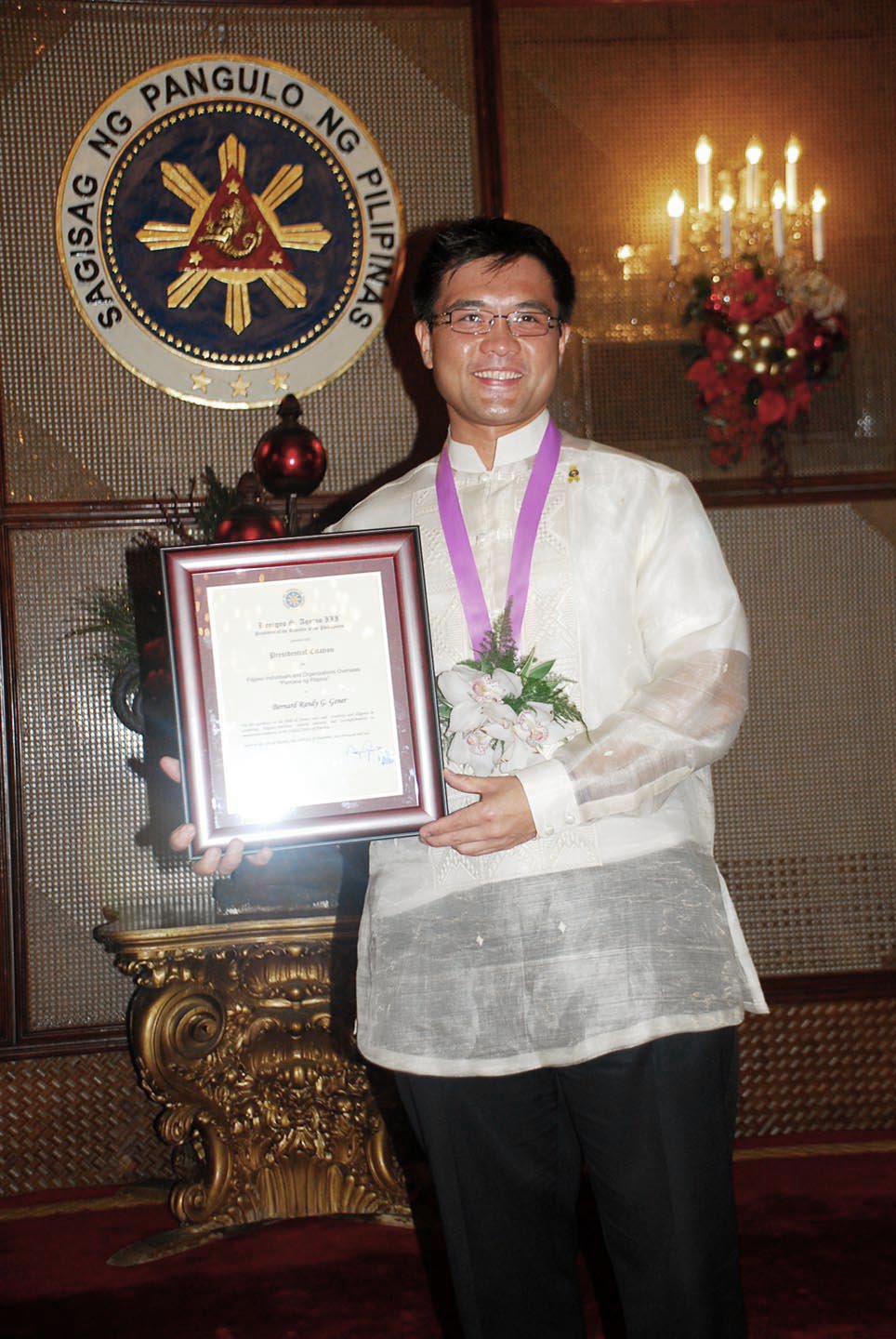
    "American Theatre's Randy Gener Receives Presidential Award" in Filipinas Magazine.
    "American Theatre's Randy Gener Conferred Presidential Award" in Pinoy Global Online News.
    "President Aquino Bestows Randy Gener Title 'Legacy of Filipino Nation'" in ArtAct Magazine.


    --> International Festival for Musical Performing Arts
    November 2010 / National Operetta Theatre “Ion Dacian“ / Bucharest, Romania

    Randy Gener and Michael John LaChiusa at National Operetta Theatre in Bucharest, Romania 
    Organizer and Moderator / “Musical Theatre in the U.S.A.: From Page to Stage”
    Led a conference on American musical theater at the International Festival for Musical Performing Arts, a one-of-kind event in Romania. The conference discussed the elements of what makes a great musical and offers Romanian audiences a glimpse beyond the proscenium into the creative worlds of musical theater writing and musical performance. 

    Organized a delegation of American musical theater artists composed of composer/lyricist/librettist Michael John LaChiusa (Hello Again and The Wild Party) and singer/performer/recording artist Jose Llana (Wonderland and Flower Drum Song).

    Press coverage:
    Gabriela Lupu, "Musicaluri despre papanasi si carnati" in Romania Libera.
    Constantina-Gabriela Moateru and Sora Mihaela Eliza, "Life is Beautiful!" in Radio Romania Cultural.
    Maria Zarnescu, "Musical Life Is Beautiful" in Critical Stages, The IATC WebJournal.
    Calin Angheluta, "Festivalul International al Artelor Spectacolului Muzical 'Viata e frumoasa'" in Agentia AmosNews.


      --> Stepping Out of Bounds: New Play Development from an International and National Perspective
      October 2010 / Lark Play Development Center / New York, NY

      Panelist
      Participated in an informal roundtable discussion with 8 playwrights of the Lark Play Development Center, along with artistic producers and international artists Katja Heiminga, Kate Loewald, Amy Mueller and Janice Poon. Moderated by Lisa Rothe.


        --> Perspectives on Criticism
        August 2010 / DC Theatre Scene and Woolly Mammoth Theatre / Washington, D.C.

        Guest Speaker
        Led a seminar and workshop given to 20 online critics and regular reviewers of DC Theatre Scene, Washington‘s liveliest theater website. How does/can/should a critic weight the value of powerful description with that of subjective candor? Is there poetry to be found in creativity? Or are the best reviews the most overtly/strongly opinionated.


        --> IATC World Congress: "Re-Defining Femininity in Today's Theater"
        June 2010 / International Association of Theater Critics (IATC) and Armenian Center of the International Theatre Institute / Yerevan, Armenia

        IATC Thalia Prize winner Richard Schechner and Randy Gener at IATC World Congress in Armenia
        Organizer and Moderator with Margareta Sorenson (Sweden) and Jean-Pierre Han (France)
        Organized and moderated a world congress of scholars and theater critics from France, Canada, Quebec, India, Korea, Japan, Lithuania, Greece, Iran, Hungary, Latvia and the USA, each one offering fresh perspectives on the roles of memory, politcs, gender, class, race and family. The concept of femininity seeks in today‘s theater its own place, language, identity and expression. In the 21st century, it has reemerged as a creative issue. Can we characterize and explain the various phenomena of this 21st century concept of femininity?
          Speaker / On Women and War: Lynn Nottage’s “Ruined”
          Delivered a paper on Lynn Nottage’s Pulitzer-winning play, published in Critical Stages, The IATC Web journal.


          --> How Are Playwrights Relevant in Today's World?
          May 2010 / Smith & Kraus Publishers and Drama Book Shop / NYC

          Panelist
          Smith & Kraus, publisher of essential books for the theater community brings together some of America’s leading playwrights and writers. Other panelists were playwright Theresa Rebeck, author Alexis Greene, Hunter College theater department chair Jonathan Kalb, and Yale Drama School and American Repertory Theater founder Robert Brustein.

          --> Koltés in America: The International Koltés Symposium
          April 2010 / Alliances Française d’Atlanta and 7Stages Theatre / Atlanta, GA

          Moderator / “The International Koltés Symposium“
          Five artists and scholars present their work on Bernard-Marie Koltés followed by a discussion and q&a. Featured were Koltes director Jean de Pangé, Koltés director Philip Boulay, University of Metz linguist Andre Petitjean, Koltés translator Maria Delgado, Witness Relocation artistic director Dan Safer.

          Press coverage
          "In Atlanta, Krumping to the Future of the Koltés Project" in TCG Circle.
          "Koltés in Atlanta," American Theatre.
          "The Koltés Mystique" in American Theatre.


          --> CUNY-TV Live Taping of "Conversations with William Hoffman"
          March 2010 / The Journalism, Communication, Theatre Department of Lehman College / Bronx, NY

          Featured TV Guest
          An hour-long televised series of discussions “with major theater and musical figures of our times” broadcast regularly on CUNY-TV, Channel 75. Our conversation aired in two parts in spring 2011.


            --> International Conference of the Indian Society for Theatre Research
            January 2010 / Indian Society for Theatre Research, International Federation for Theatre Research and Post Graduate Department of Hindi at Sardar Patel University / Gujarat, India


            At Sardar Patel University in Gujarat, India
            Moderator / “Indian Theatre: Regional, National and International Perspectives”
            Moderated two seminars focusing on contemporary Indian theatre from regional, national and perspectives. The conference also addressed the diverse and multiple nature of Indian theater criticism, its present position, and its required and essential new directions.
              Lecturer / “Storytelling By Digital Design: How New Technology Transforms the Way We Create Theatre”
              The idea that hyper-mediated practices challenge the authority normally vested in a text is a long-accepted avant-garde trope. But this notion is merely grist in contemporary theatre where rapid developments in animation, video game and computer technologies have profoundly affected the domain of narrative, story architecture and performance design.

                Thursday, August 18, 2011

                Randy Gener Publishes in the Iranian City of Tehran


                TEHRAN, IRAN:   Randy Gener's essay, "Reorientalism," about the emergence of a new category of Middle East-American drama in the U.S., has been published in a new anthology of critical essays and scholarly articles as part of an annual festival held in the Iranian capital city of Tehran.

                Released in three languages (English, Persian and French), the book, entitled "About the Phenomenon of Theatre," was published by Namayesh, a state subsidized theater magazine in Iran.  It was compiled by Nasrollah Ghaderi, in cooperation with Katayoon Hussein zadeh and Ali Najafi.

                "About the Phenomenon of Theatre" was officially released in February 2011 during the 29th edition of the Fajr International Theatre Festival where a majority of the awards went to Iran, Germany, Italy and Estonia.  The book was then distributed during the 2011 edition of the Europe Theatre Prize, which took place in St. Petersburg in Russia.

                In an interview with the Iran Book News Agency, Katayoon Hussein zadeh describes the anthology's main thrust: "Most of the articles are about documentary theatre, political theatre, the formation of political theatre and its process. Every writer has presented his work according to the art in his country. The article's analytic information is incredible. Such a kind of book was not released in Iran so far."

                Moreover she said that distributing the book during the awarding ceremonies of the European Theater Prize (Premio Europa) in St. Petersburg was an opportunity for an international audience to appreciate the high-quality of critical essays being published in Iran today.

                The book is divided into English and French sections. The English section included such essays as:
                • "Idioms of South Asian Theater" by Abhi Subedi;
                • "At the Crossroads" by Andrzej Zurowski, about Polish theater;
                • "The theatre and economics, the British experience" by John Elsom;
                • "Chinese women's liberation road on the stage" by Dr. Zhu Ning;
                • "Enchanted by the BRAVE festival" by Kalina Stefanova of Bulgaria;
                • "Slovenian drama as the globalization's litmus test" by Kristof Jacek kozak;
                • "The importance of being obedient" by the Finnish critic Matti Linnavuori;
                • "Where is the emerging point in today's Swedish performing arts" by Margareta Sorenson;
                • "The Barbican international theatre event in London" by Maria Shevtsova
                • "The national theatre of Scotland, a theatre without walls" by Mark Brown
                • "Theatre of revolution-history, theatre, document and life" by Petr Christov of the Czech Republic;
                • "Two Lithuanian Hamlets: The metaphysics of ice and mirrors" by Ramune Marcinkeviciute;
                • "Reorientalism," a critical essay about the emergence of Arab-American theater voices, by Randy Gener of the USA;
                • "Who will be the king or directors' merciless fight for power against playwright in the European theatre" by Sanja Nikcevic of Croatia;
                • "National critics and the postmodern world: bridging the gap" by Savas Patsalidis of Greece;
                • "The community sensitive theatre maker" by Tamas Jaszay;
                • "Contemporary performance or whatever happened to the performative revolution" by Tomaz Toporisic;
                • "The burden of existence" by Tomasz Milkowski of Poland;
                • "The critical reception of Eastern/ Central European theater in Korea since 1989 by Yun-Cheol Kim of South Korea; and
                • "European theatre 2000-2010" by Ian Herbert of the U.K.
                Gener's essay, "Reorientalism," greatly expands on an initial report he had written in 2010 about San Francisco's ReOrient Festival at Theatre Artaud in San Francisco, organized by Golden Thread Productions. At the time of this festival, President Barack Obama gave an Afghanistan war speech at West Point that left many Americans feeling deja vu all over again. "I have determined that it is in our vital national interest to send an additional 30,000 U.S. troops to Afghanistan," the president said. The rest of Obama's speech suggested that  U.S. interests, its means and its responsibilities are finite in Afghanistan, but they do exist. As Obama put it, "We simply can't afford to ignore the price of these wars."

                Using Obama's history-in-the-making war speech, "Reorientalism" offers a critical context on the emergence of a new genre of Middle Eastern-American drama in the U.S. and surveys in more comprehensive depth the new voices, ensembles and theater companies that have represented that specific immigrant community. (A shorter version of this essay had appeared in the March 2010 issue of American Theatre magazine.)

                During this year's event, the Fajr International Theatre Festival presented about 153 performances by Iranian and 3 international ensembles.  Iranian performers put on stage some 137 works from different cities including Mashhad, Karaj, Kermanshah, Varamin, Sanandaj, Isfahan, Tabriz, Lahijan, Sari and Yazd.

                Groups from Italy, the Czech Republic, Russia, Switzerland, China, Germany, Canada, South Korea, Greece, Poland and Estonia also participated in the festival. The 2011 Fajr International Theater Festival was held from February 5 to 20 in the Iranian provinces of Alborz, Tehran, Gilan, Golestan and North Khorasan.

                Iran holds international Fajr film, theater, music and visual arts festivals on a yearly basis to mark the anniversary of the 1979 Islamic Revolution.

                Sunday, May 29, 2011

                Randy Gener Appointed Editor-in-Chief of Prague Quadrennial Newspaper


                Gener will also host daily gallery talks at USA National Exhibition entry to Prague Quadrennial, the “Olympics of Theater Design,” June 16–26

                PRAGUE, Czech Republic, 6.1.2011 — Randy Gener, the Nathan Award–winning editor, writer and drama critic, has been appointed Editor-in-Chief of the Prague Quadrennial Newspaper in the Czech Republic.

                Gener returns to Prague, having served in June 2007 as Editor and Columnist of Prague Quadrennial Today as well as Scenofest Team Leader of the press/publication project of the Prague Quadrennial‘s educational events, known as Scenofest, organized in joint cooperation with OISTAT, the International Organization of Scenographers, Theatre Architects and Technicians.  In 2007, with the generous support of the Ford Foundation/Institute of International Education, Gener also presented two lecture presentations on narrative design and contemporary currents in U.S. theater design.

                Under construction: PQ's Intersection architecture. Photo by Miroslav Halada 
                A broadsheet, the Prague Quadrennial Newspaper will take a lively, irreverent, pop-culture approach to covering PQ events. Published in English and Czech languages, the daily paper will be distributed throughout the city center of Prague for the 11-day duration of the Prague Quadrennial of Performance Design and Space.  One of the world’s largest theater events held every four years since 1967, the Prague Quadrennial will take place from June 16 to 26, 2011.

                “The PQ is the planet’s largest competitive exposition of contemporary stage design and theater architecture,” states Randy Gener in “All the World’s a Pavilion” (American Theatre, September 2007).  “PQ is to the Czech Republic what the Venice Biennale is to Italy  — a global tapas where everyone who cares about the stage flocks to look, sample and judge the state of new theater from around the world.”

                In addition to producing and editing a daily paper, Gener will co-host a series of gallery talks with renowned U.S. designers at the USA National exhibition, From the Edge.  The talks will be held daily at 4:00 pm at Veletzrini Palace, Prague’s national gallery.  From the Edge’s gallery talks will showcase, among others, SITI Company’s BobRauschenbergAmerica; The Civilians’ This Beautiful City; Ping Chong & Company’s Cocktail and Inside Out; 3-Legged Dog’s Fire Island; Goodman Theatre of Chicago’s Desire Under the Elms; Second Stage’s The Elaborate Entrance of Chad Deity; Pig Iron Theatre Company’s Love Unpunished; Nancy Keystone and Justin Townsend’s productions of Apollo and Suzan-Lori Parks’s The America Play.

                Curated by the costume designer and Carnegie Mellon University professor Susan Tsu for the USITT, the United States association of design, production and technology professionals in the entertainment industry, From the Edge will be the 10th time the USA is represented at the Prague Quadrennial where it will compete with a record number of 62 countries for the Golden Triga and other medals.  The USA will also participate in the Architecture competition, the Student Section competition and the Extreme Costume exhibition.

                Under construction: PQ's Intersection architecture. Photo by Miroslav Halada
                Randy Gener is a New York City–based writer, editor, curator and drama critic. His nonfiction writing, journalism and art criticism have appeared in The New York Times, Expressen, Norwegian Shakespeare and Theatre Magazine, Mumbia Theatre Guide, The International Herald Tribune, The Star Ledger, The Village Voice, The Daily News, Time Out New York, New York magazine, Gannett Newspapers, Korean Theatre Journal and other publications in Europe, Asia and the United States.  A major contributor to the encyclopedia Cambridge Guide to the American Theater, as well as scholarly books and play anthologies, Gener is Section Editor of Critical Stages, the web journal of the International Association of Theatre Critics, a UNESCO-affiliated organization founded in Paris in 1956.

                In 2010, Gener won two travel media awards from the North American Travel Journalists Association for excellence in travel writing, the SPJ Deadline Club Award for Best Arts Reporting from the New York chapter of the Society of Professional Journalists (“for shedding light on government censorship and repression of artists”); and Journalist of the Year 2010 from the National Lesbian & Gay Journalists Association.  Gener is the 2009 recipient of the George Jean Nathan Award for Dramatic Criticism — the highest U.S. award for dramatic criticism and one of the most distinguished awards in the American theater — for his essays in American Theatre magazine, published by Theatre Communications Group.  Gener was conferred a 2010 Pamana ng Pilipino Presidential Award by His Excellency Benigno S. Aquino III, President of the Philippines (the title translates as “Legacy of the Filipino Nation”).
                Krétakör's Apology of the Escapologist. Photo by Péter Francsikai 

                The Prague Quadrennial of Performance Design and Space is organized and funded by the Ministry of Culture of the Czech Republic and realized by Prague’s Arts and Theatre Institute.

                Under the auspices of the President of the Czech Republic Václav Klaus, the Mayor of the City of Prague Bohuslav Svoboda and the Mayor of Prague 7 Marek Ječmének.

                With the support of the Culture Program of the European Union. Supported by UNESCO, Trust for Mutual Understanding, the City of Prague, Czech-German Fund For The Future.

                Press contact for media:
                Nathalie Frank
                International Public Relations
                Prague Quadrennial of Performance Design and Space
                June 16 – 26, 2011
                Celetná 17 | 110 00 Prague 1
                Czech Republic 
                Tel. +420 224 809 102 
                Fax +420 224 809 225
                Cell. +420 774 255 867
                E nathalie.frank@pq.cz

                Links to PQ communication channels:
                Intersection: http://www.pq.cz/en/intersections.html


                FOR EDITORS AND JOURNALISTS:


                WHAT IS THE PRAGUE QUADRENNIAL?
                The world’s largest performance design event, the 12th Prague Quadrennial of Performance Design and Space is a presentation of contemporary work in a variety of performance design disciplines and genres, including costume, stage, light, sound design, and theatre architecture for dance, opera, drama, site specific, multi-media performances, and performance art. 

                Coming to Prague will also allow visitors to discover a unique outdoor performing exhibition, Intersection: Intimacy & Spectacle, presenting thirty internationally acclaimed artists, including Romeo Castellucci, Anna Viebrock, Ilya and Emilia Kabakov, Nathaniel Mellors, and Josef Nadj.  Additionally, a large number of projects will take place in public spaces throughout the city — a unique occasion to discover Prague through the eyes of the world’s contemporary arts.  

                Visitors will also be able to explore various disciplines essential to the performing arts thanks to projects focused on lighting and sound design, architecture, and costumes, as well as talks with personalities such as Arata Isozaki, Es Devlin, Eiko Ishioka, Richard Sennett, Alan Read, and many more.

                Romeo Castellucci's Persona.  Picture composed by Romeo Castellucci.


                Participating countries in the International Competitive Exhibition Argentina // Armenia // Australia // Austria // Belarus // Belgium // Brazil // Bulgaria // Canada // Chile // China // Colombia // Croatia // Cuba // Cyprus // Czech Republic // Denmark // Estonia // Finland // France // Georgia // Germany // Greece // Hong Kong // Hungary // Iceland // India // Israel // Italy // Japan // Kazakhstan // Republic of Korea // Latvia // Lebanon // Lithuania // Macedonia // Mongolia // Mexico // Netherlands // New Zealand // Nigeria // Norway // Peru // Philippines // Poland // Portugal // Republic of South Africa // Romania // Russia // Serbia // Singapore // Slovakia // Slovenia // Spain // Sweden // Switzerland // Taiwan // Turkey // United Kingdom // Uruguay // USA // Venezuela

                Participating artists in the Intersection project Romeo Castellucci / Socìetas Raffaello Sanzio // Josef Nadj // Anna Viebrock / Till Exit // Nathaniel Mellors // Ana Borralho & João Galante // Markus Schinwald // Mareunrol’s // Brett Bailey // Hooman Sharifi // Ilya and Emilia Kabakov // Monika Pormale // Hans Rosenström // Josef Bolf // Guerra de la Paz // Monika Pormale // Terike Haapoja // Egon Tobiáš // Elevator Repair Service // Ioana Mona Popovici & Simon Vincenzi // Ulla von Brandenburg // Caroline Evans & Hansjorg Schmidt // Bohdan Holomíček & Eva Hrubá // Abbey Theatre // Harun Farocki // Dace Džeriņa // Paul Divjak // Dejan Kaludjerović // Kateřina Fojtíková // Tomáš Svoboda // Stage Code & La grande bande // Handa Gote // Jan Lepšík // Alice Nellis // Árpád Schilling / Krétakör // Claudia Bosse / theatercombinat

                WHAT IS FROM THE EDGE?
                USITT–USA National Exhibit website: 2011exhibit.usitt.org/pq2011

                Pat Oleszko's Betty Boob on the beach
                From the Edge, the exhibition representing the US at the 12th Prague Quadrennial, celebrates vital new designs mirroring the socio-political issues consuming American performance makers today, such as issues of identity, healing, and obsessions with death and loss after 9/11 and hurricane Katrina; the pull of conscience that is inevitable when engaged in war; the politics of eating, tensions relative to race and gender; anxieties about technology… thus featuring the work of 36 design collaborations, both self-reflective and self-critical in nature.

                The US will also compete within the Architecture Section of the Prague Quadrennial with an exhibit From Sea to Sea, presenting hundreds of spaces for the performing arts that have been constructed in the US since 2006, from the traditional regional performance center, concert hall, community store theatre, primary school theatres, and ad hoc outdoor venues to experimental performance spaces. The US will also participate in the Student Section with Emerge, a project showcasing the work of over 250 American student designers from 47 colleges and universities, and including a participatory portion inviting viewers to see the exhibit evolving while the students will be creating. As part of the Extreme Costume competitive exhibition, costumes by Pat Oleszko, Constance Hoffman, and Achim Freyer will be on display.  

                In the past U.S. exhibitors have often received some of the PQ’s most prestigious awards.  The US exhibit won the Golden Triga in 1987, the Silver and the Golden Medal in the Thematic Section in 1991 and in 1995, and a Special Honorary Diploma in 2003

                Tuesday, February 15, 2011

                Randy Gener Featured in NLGJA News

                Check out this lovely item posted in the February 2011 edition of NLGJA News, the webjournal of the National Lesbian and Gay Journalists Association. If the links above do not work, copy and paste this URL (http://www.nlgja.org/nlgjanews/archives/314) in your browser.

                This news item includes a photo of me and His Excellency Benigno S. Aquino III, president of the Philippines.

                Also, according to the NLGJA staff, "Oriol Gutierez has written a timely piece on NLGJA's need for more diversity, and a call for leadership to lead in the effort. Doug Stewart brings us an update on the progress of their newsroom, which recently combined print and broadcast under one roof. Is it succeeding? What works and what doesn't?"

                I wish to send my heartfelt congratulations to Michael Luongo who won five awards from the North American Travel Journalists Association 2010 Awards competition, including the NATJA 2010 Grand Prize for Travel Journalism, based on a package of work covering Iraq, Palestine and other Middle Eastern desginations. Bravo! -- Gener