Thursday, October 27, 2011

Randy Gener represents US media in German Embassy's first German and American Media Dialogue Nov. 6 and 7 in Washington, D.C.

WASHINGTON, D.C.: Randy Gener is representing the U.S. media in the first-ever German and American Media Dialogue, organized by the Embassy of the Federal Republic of Germany in Washington, D.C.

The Media Dialogue is part of a series of D.C. events, taking place on the weekend of November 6 and 7., and is organized in cooperation with the Studio Theater and the Goethe-Institut in D.C.

To RSVP, visit the official website of German Missions in the United States at
http://www.germany.info/Vertretung/usa/en/__events/Wash/2011/11/07__MediaDialogue.html

Or, contact Goethe-Institut, 812 Seventh Street NW, Washington, DC
RSVP: 202-289-1200 ext 162 orrsvp@washington.goethe.org
Devoted to contemporary theate, the event begins with the press premiere of The Golden Dragon by German playwright Roland Schimmelpfennig at the Studio Theater on Sunday, November 6. Schimmelpfennig will be in attendance.

The Media Dialogue, which takes place at the Goethe-Institut, on Monday November 7 from 10 a.m. to 1 p.m., consists of a public discussion among German and American theater critics.

The discussion will address current trends in contemporary theater in Germany and in the U.S.  It will also launch a sustained dialogue among theater critics between the two countries.

The Media Dialogue will be taped and made available electronically over the Internet. It is planned to provide simultaneous translation for the event. The German critics who are confirmed to participate are Peter Kümmel, theater critic for the newspaper Die Zeit, and Peter Michalzik, journalist and theater critic for the newspaper Frankfurter Rundschau.

The Golden Dragon takes place in the cramped kitchen of an Asian restaurant, where four cooks pull the tooth of a young Chinese co-worker. "His tooth," adds the play's description in the Studio Theater website, "ends up in the Thai soup of a flight attendant—who overhears the fight of a young couple who live above the restaurant, whose fighting disturbs the shopkeeper of the dry goods store next door to the restaurant, who is more connected to the young Chinese man than anyone suspects. A kaleidoscopic look at a globalized world, this play by one of Germany’s most innovative and adventurous writers unfolds in brief and fierce comic scenes. Five actors cross age, race, and gender to play 15 characters in this vicious, poetic, and surprisingly moving investigation of how intertwined our lives really are."

Directed by Serge Seiden, the U.S. premiere of The Golden Dragon features Deb Booth's set design, Michael Giannitti's lighting design, Helen Huang's costume design, and Evan Rogers's sound design. The cast includes Sarah Marshall, Joseph Anthony Foronda, Amir Darvish, KK Moggie and Chris Myers. The play runs November 2 – December 11, 2011. Studio Theatre is located at 1501 14th St. NW, Washington, D.C. 20005. Phone: (202) 332-3300. V/TTY: 202-667-8436. Email: studio@studiotheatre.org.

Roland Schimmelpfennig is Germany’s most produced playwright. His plays have been translated into over 20 languages and performed in 40 countries. His plays include Hier und Jetzt (Here and Now), Die Frau von früher (The Woman from the Past), Vorher/Nachher (Before/Afterwards), Die arabische Nacht (The Arabian Night), Push up 1-3, Peggy Pickit sieht das Gesicht Gottes (Peggy Pickit Sees the Face of God), and Der goldene Drache (The Golden Dragon). His writing has won most of the prestigious prizes in Germany, including the 1997 Else-Lasker-Schüler-Preis for Fisch um Fisch (Fish for Fish), the Nestroy Prize for best young author in 2002, and the Nestroy Prize for the best play for Besuch bei dem Vater (Visit at the Father) in 2009. The Golden Dragon was awarded the Mühlheimer Dramatists Award and was chosen as Theater Heute’s Play of the Year. In 2010, Schimmelpfennig received the highest playwriting award in Germany, the Else-Lasker-Schüler-Prize, to honor his body of work.

Known for his surprising juxtapositions of lyricism and violence, as well as his breadth of storytelling techniques, Schimmelpfennig’s work shares recurrent themes of alienation and connection, desire and regret, along with the peculiar ways his language unfolds. Marked by a direct and almost clipped diction, his language can be both brutal and near-mythic by turns. His characters are frequently isolated from one another, but share a set of images and experiences that suggest a connection they rarely recognize, even when they’re literally sharing dreams.

London production of The Golden Dragon
David Tushingham, who has translated many of Schimmelpfennig’s work into English (including The Golden Dragon), links his language and thematic interests: “His work is always functioning on different levels at the same time. Structurally, you’ll have elements of a fairy tale and elements that are more realistic. But his language combines elements of contemporary life in a way that is quite elegant, both humorous and surprisingly serious at the same time.”

Both the German American Media Dialogue and the Studio Theatre production of The Golden Dragon are also part of Zeitgeist DC Contemporary Literature Series, a program dedicated to fostering cross-cultural experiences by bringing to the Washington, D.C. community the most interesting, serious-minded literary artists speaking about pressing contemporary issues. 

Saturday, October 15, 2011

Randy Gener and Flemish director Ivo van Hove talk "Movies and Theater" at Brooklyn Academy of Music

BROOKLYN:  Randy Gener joins the internationally acclaimed Flemish director Ivo van Hove — whose work Cate Blanchett describes as "stunning, with a capital 'S' " — in a BAMtalk entitled "Movies and Theater."  The conversation takes places Wednesday, October 26, 2011 at 6:00 pm at BAM Rose Cinemas.

Gener's hour-long BAMtalk with Ivo van Hove is a featured event of the Brooklyn Academy of Music's U.S. premiere of Cries and Whispers by Ingmar Bergman.

Part of the 2011 BAM Next Wave Festival, Cries and Whispers performs October 25—29, 2011 at 7:30pm at BAM Harvey Theater.


Ivo van Hove


Performed in Dutch with English titles, Ivo van Hove's Cries and Whispers is a stage adaptation of the classic 1972 film by the late Swedish filmmaker Ingmar Bergman. "To be able to work with Bergman’s complex evocation of human suffering and compassion is both a challenge and an honor,” van Hove says.


Performed by the members of Toneelgroep Amsterdam, where Van Hove is the artistic director, this production was made possible with the cooperation of Auteursrechtenbureau ALMO, in association with Josef Weinberger Ltd, London and the Ingmar Bergman Foundation. Toneelgroep Amsterdam's Cries and Whispers was first performed at the Ingmar Bergman International Theatre Festival 2009.

Nathan Award–winning editor and writer Randy Gener visited Sweden's Royal Dramatic Theater in Stockholm to attend the Ingmar Bergman International Theatre Festival. He was the first American critic to see and write about van Hove's production.

Here is an excerpt from Gener's critical essay on the work and career of Ivo van Hove, "A Passion for Extremes" — it was the cover story of the November 2009 edition of American Theatre magazine:
In his book Images: My Life in Film, Ingmar Bergman wrote: "All my films can be thought of in terms of black and white, except for Cries and Whispers. In the screenplay, I say that I have thought of the color red as the interior of the soul." Thanks to a close collaboration with the great cinematographer Sven Nykvist, Bergman saturated his emotionally charged 1972 film about the rapier masochism of sisterhood and family life with a striking color palette made almost exclusively of crimson, black and white (which the Swedish filmmaker associated with the themes of blood, religion and sexual repression).

A bleak yet hypnotic portrayal of pain and suffering,  Cries and Whispers takes place inside a tomb-like manor house at the turn of the century. Structured as a gliding series of memories, flashbacks, devastating confrontations and fleshy close-ups that fade out into deep reds, Bergman's story compels us to observe the frustrated lives and emotional horrors of four women. Agnes, a virginal spinster, is dying of cancer of the womb. Her two unhappily married sisters have come to attend her in her final agony. Callously, they watch and wait, along with Anna, a reliable maid, during the last two days of Agnes's life.
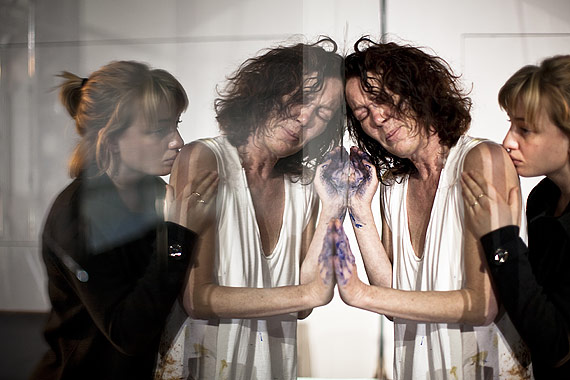
In van Hove, Bergman finds a perfect appositive. Turning away from the strong valences invoked by red, van Hove's Agnes slathers thick impastos of Yves Klein blue (or IKB, as it is known in art circles) on the glass partitions and white canvases that effortlessly slide in and out of Versweyvald's layered, open-space set—a sleek coalescence of video workshop, kitchen, living room and austere bedroom. 
Based on a few lines of description in Bergman's script ("She has vague artistic ambitions—dabbling in painting..." and "Agnes's painting is generously colorful and somewhat romantic. Her main subject is flowers"), van Hove re-conceives Agnes as a performance artist whose obsession with her video diaries substitutes for the human affection and sense of community she so desperately hungers for.
ingmar Bergman's Cries and Whispers | Photograph by Chris Nietvelt and Jan  Versweyveld
Van Hove's Cries and Whispers fuses uninhibited acting, chic-sterile stage design, contemporary attired, loud pop/hard-rock music and live-video footage to create an installation-style atmosphere. Except for replicating a sculptural pose of a dying Agnes that suggests a Pieta, van Hove's misc-en-scene does not imitate Bergman's softer film style. Van Hove's urgent production theatricalizes the jumbled phases of a mourning process. It moves and feels like a 19th-century allegory in a 21st-century hybrid-art form.
 And van Hove's version of Cries and Whispers is more heart-wrenching when it departs from Ingmar Bergman."

The Nathan Award–winning Randy Gener replaces MacArthur genius and Pulitzer Prize–winning playwright Suzan-Lori Parks, whose name was originally advertised in the BAM Next Wave Festival brochure. ###


ARTIST TALK: "MOVIES AND THEATER"
Ivo van Hove with Randy Gener

Part of the 2011 BAM Next Wave Festival
Ivo van Hove's staging of Ingmar Bergman's Cries and Whispers

Wed., Oct. 26, 2011 at 6pm

BAM Rose Cinemas
1 hr.
$10; $5 for Friends of BAM


U.S. Premiere
CRIES AND WHISPERS


Part of the 2011 BAM Next Wave Festival


Oct. 25–29, 2011 at 7:30pm


U.S. Premiere


By Ingmar Bergman
Toneelgroep Amsterdam
Directed by Ivon van Hove


In Dutch with English titles
Scenography by Jan Versweyveld
Dramaturgy by Peter van Kraaij
Video design by Tal Yarden
Costume design by Wojciech Dziedzic
Sound design by Roeland Fernhout


In a sterile grey room, an artist lies dying. Her video diaries flicker on screens, offering consoling images of an ersatz immortality as her estranged sisters hover about, removed. Not a word has been uttered and already director Ivo van Hove (Opening Night, 2008 Next Wave) has transported us to a collective soul bound by the most tenuous compassion. On a stage transfigured by grief, gripping performances from Dutch repertory company Toneelgroep Amsterdam drive this modern adaptation of Ingmar Bergman’s unflinching 1972 film about the will to live and the astounding human capacity for empathy amid the debris of damaged life.
BAM Harvey Theater

Run time: 1hr 45min
Season tickets start at $17.50
Full price tickets start at $25

Toneelgroep Amsterdam / deSingel Antwerpen / Ingmar Bergman International Theatre Festival 2009

Tuesday, October 11, 2011

Randy Gener leads "Advancing the Creativity of the Artist" panel in a two-day Africa arts symposium at Columbia University

NEW YORK CITY:  Randy Gener will serve as moderator and facilitator at a two-day symposium, Dialogues Across Culture: A Model for Building Enduring Partnerships, presented by MAPP International Productions and the Africa Contemporary Arts Consortium at Columbia University in New York City.


In the second day of the symposium (October 29), Gener will lead a public conversation, "Advancing the Creativity of the Artist," featuring Faustin Linyekula, artist from the Democratic Republic of Congo, and Ralph Lemon, New York City–based artist. The conversation will take place at the Institute of African Studies at Columbia University, located at 606 West 122nd Street in New York City.


Dialogues Across Culture takes a step back to reflect on international cultural exchanges between the United States and Africa. Organized in partnership with the Museum for African Art, The Center for African Education at Teachers College and the Institute of African Studies, this free symposium will take place Friday, October 28 (7pm-9pm) and Saturday, October 29 (11am-4pm) at Columbia University. 

Faustin Linyekula and Papy Ebotani 
Dialogues Across Culture: A Model for Building Enduring Partnerships is designed to open up conversations around international cultural exchange; to share lessons learned through case studies; to introduce projects and artists with whom the Africa Contemporary Arts Consortium has partnered; and to promote and build understanding and connections between artists, organizations and public communities in the United States and on the African continent.


The activities of the symposium include informal performances by choreographers Faustin Linyekula from the Democratic Republic of Congo and Maria Helena Pinto from Mozambique. There will be presentations and discussions with members of the Africa Contemporary Arts Consortium, MAPP, the Museum of African Art and Columbia University faculty. 


Faustin Linyekula
Faustin Linyekula is a Congolese dancer and choreographer of contemporary dance. His works are structured along the lines of the dance form Ndombolo and its associated music and address "the legacy of war, terror, fear and the collapse of the economy for himself, his family and his friends." Linyekula has been part of a think tank with other African artists and intellectuals around the creation of an arts center near Cape Town, South Africa. The think tank resulted in the creation of the Africa Centre. Based in Kisangani, Linyekula heads the Studios Kabako whose local artistic initiatives embrace the fields of dance, theatre, music and video.


Ralph Lemon
Ralph Lemon is artistic director of Cross Performance, a company dedicated to the creation of cross-cultural and cross-disciplinary performance and presentations. Lemon's projects expand the definition of choreography by crossing and stretching the boundaries between Western, post-modern dance and other art forms and culture. In 2005, Lemon concluded The Geography Trilogy, a decade-long international research and performance project that spanned three continents as it explored race, history and memory. In 2010, Lemon curated I Get Lost, a performance and discussion series for Danspace Project, NYC.


Dialogues Across Culture has been generously supported by The Doris Duke Charitable Foundation and the National Endowment for the Arts. This program is supported, in part, by public funds from the New York City Department of Culture.


A SCHEDULE OF EVENTS:

Performance by Faustin Linyekula and Maria Helena Pinto
Friday, October 28, 2011 (7:00pm - 9:00pm)
Location: Milbank Chapel, Teachers College
Enter on 120th Street midway between Broadway and Amsterdam
Reception to follow
Free and open to the public; ID required
RSVP here: http://dialoguesacrossculture102811.eventbrite.com


Plenary session, interviews with artists, project presentations, 
discussions and focused conversations 

Saturday, October 29 (11am to 4pm)
Date: Saturday, October 29, 2011 Time: 11:00am - 4:00pm
Location: The Institute of African Studies, Columbia University, 606 West 122nd Street
Free and open to the public; ID required
RSVP here: http://dialoguesacrossculture102911.eventbrite.com

Investing in Curatorial Research
Dana Elmquist, Producer of Theater Programs at the Museum for African Art (NY)
Lisa Binder, Visual Art Curator, the Museum for African Art (NY)
Ken Foster, Executive Director, Yerba Buena Center for the Arts (San Francisco)

Advancing the Creativity of the Artist
Faustin Linyekula, Artist (Democratic Republic of Congo)
Ralph Lemon, Artist (NY)
Randy Gener, Critical Stages (NY)

Connecting Artists and Communities
Maria Helena Pinto, Artist (Mozambique)
Laura Faure, Director, Bates Dance Festival (Lewiston, ME)

Building and Sharing Knowledge
Zoe Strother, Professor of African Art at Columbia University (NY)
Ann-Marie Bouttiaux, Royal Museum for Central Africa (Brussels)
Joan Frosch, Director, World Arts 
Culture at University of Florida (Gainesville)


Admission for both days is free. Reservations required.  


For more information, contact Cathy Zimmerman at MAPP International Productions, 646-602-9390 or cathy@mappinternational.org.

To RSVP for the event, visit http://dialoguesacrossculture102811.eventbrite.com


*****

The Africa Contemporary Arts Consortium is a landmark program founded in 2004 to initiate, develop and sustain a dynamic exchange of arts and ideas between artists, arts organizations and public communities throughout the U.S. and the African continent.  The Consortium is dedicated to working with African artists who are interpreting contemporary life through diverse modes of performance, with programs rooted in experiential opportunities that nurture conversation and exchange and allow organic connections to evolve.  Co-founded by MAPP International Productions and nine partner organizations, the Consortium has connected thousands of U.S. citizens-in 31 cities in 21 states-to 52 African artists from 15 different countries through performances and participatory activities.

MAPP International Productions is a nonprofit producing organization dedicated to developing functional and sustainable environments for artists to create, premiere and tour ambitious and compelling performing arts projects. MAPP provides support and opportunities for challenging artistic voices to be fully heard and engaged by bringing together arts, humanities and public dialogue. Envisioning artists as agents of change, MAPP advocates for vital artistic exchange across cultures and borders through sustained and evolving partnerships between artists, arts organizers, educational institutions, cultural organizations and public communities. Since 1994, MAPP has produced 30 acclaimed multidisciplinary projects, created and performed by nearly 300 artists; produced over 60 multi-city tours of U.S. artists and artists from 22 countries in Asia, Africa, Europe and the Caribbean, taking productions and engagement activities to audiences in 42 U.S. states; and founded and led networks for international exchange with artists in Africa, the Caribbean, and Europe.

The Museum for African Art - a major center for African art and culture - has, since opening to the public in 1984, organized more than sixty exhibitions and produced engaging publications of the highest scholarly merit. Together, these and a broad range of public programs have illuminated Africa's rich artistic traditions and cultures. Today, as it prepares to move into its new home on Fifth Avenue at 110th Street in Manhattan, the Museum is expanding its agenda of exhibitions and educational activities.

The Institute of African Studies (IAS) is Columbia University's central forum and resource for African-centered academic research, program development, curriculum administration, student advisement, and local, national, and international dialogue and action on Africa. Founded in 1959, the IAS prepares generations of Africa practitioners for careers in development, diplomacy, business, governance, journalism, law, human rights, academic research, and teaching.

The Center for African Education promotes research and teaching about education, broadly defined, in Africa and the African Diaspora. Its central aim is to create a community of students, faculty, and staff with common interests and commitments to the fields of Education and African Studies through interdisciplinary study and discussion across Teachers College and Columbia University. The Center also promotes linkages with African universities by hosting visiting scholars, policy makers, practitioners, and activists who present different disciplinary and theoretical perspectives; and provides a forum for students to discuss their research and interests with African scholars, Africanist faculty, and colleagues at conferences, public lectures, and seminars


Thursday, September 29, 2011

Randy Gener serves as U.S. jury member for MESS Sarajevo International Festival

SARAJEVO: Randy Gener will serve as the U.S. juror of an international jury of leading artists, top editors and prominent critics of the 51st edition of the MESS Sarajevo International Theater Festival  in Bosnia and Herzegovina, the oldest international theatre festival in the Balkans.

Poster of 2011 MESS Sarajevo
This festival is produced by the National Theatre of Sarajevo, famously known as the Bosnian theater where Susan Sontag staged a production of Samuel Beckett's Waiting for Godot in the midst of the Siege of Sarajevo in 1993. Sontag's production drew so much attention to the city's plight that many Bosnians believe it helped end the war. A square outside Sarajevo's national theater is dedicated to the U.S. writer and activist who died in 2004.

This year's MESS Sarajevo International Theater Festival takes place from September 30, 2010 until October 9, 2011, presenting 32 performances from all over the world in six festival categories.

Established in 1960 by Jurislav Korenic as the Festival of Small and Experimental Stages, MESS was one of the best theatre events promoting modern theatre expression in the former Yugoslavia. "MESS" stands for Small Experimental Stage.

Today, MESS (Međunarodni teatarski festival Mess) is the most significant annual celebration of theatre art in South-East Europe and takes place in Sarajevo in the second part of October. MESS also organises MEMORY MODUL, a project aiming to investigate the way artists deal with the experience of genocide and destruction.

Click here if you want to download the entire 2011 program.

At a press conference in Sarajevo, it was announced that MESS Sarajevo will award Golden Laurel Wreaths Award for theatrical contribution to Catherine Cube, former prima ballerina of the Sarajevo National Theatre (the first non-theater artist to be recognized for lifetime achievement) and to Zarko Mijatovic, champion of the Bosnian National Theatre in Zenica. In addition, the Yugoslav Drama Theatre in Belgrade will receive a Golden Laurel Wreath given to arts institutions.

In addition to Gener, the main festival jury consists of Bosnian actress Goradana Boban, Mexico theater critic Fernando de Ita, director/scenographer from Turkey Nurul Tuncer, U.K. critic Ian Herbert, and editor of Croatian Radio Bujan Munjin.

Sarajevo is the capital of Bosnia and Herzegovina, which is also known as the Republic of Bosnia and Herzegovina. This country is located on the Balkan peninsula, which allows beautiful views, access to water sports and secluded mountainous resorts.

Bosnia and Herzegovina is bound by Croatia to the north, northwest and west — and by Montenegro and Serbia to the southeast, east and northeast. The Adriatic Sea attracts a good deal of tourists to this country's coast, especially the area near Neum.


MESS Sarajevo – International Theater Festival presents the world's top productions (usually numbering 50 shows) in a variety of artistic disciplines, from several continents each year.

Puls (Netherlands), staged by Jolika Sudermann, presented at MESS Sarajevo 2010 | Photography by Vedad Divović 

For almost two weeks each October, the festival becomes a venue for artists to exhibit their art forms and have the opportunity to work with other young artists in order to explore and nourish artistic creation.

Life With an Idiot by Ukranian director Andriey Zholdak (Romania), presented at MESS Sarajevo 2010

MESS Sarajevo festival aims to present works that integrate creative efforts of contemporary dancers and composers alike. By gathering these artists together and sharing their talents with Sarajevo's community of arts patrons, the festival feels it is making a contribution to the city's evolution.

"This is a festival with a poignantly international character, which helps us defeat ourselves and our environment, that carries the remnants of hard times," says Sarajevo Mayor Alija Behmen.

In fact, MESS Sarajevo had resisted during the seige of Sarajevo, without interrupting its efforts and even staging some historically significant plays, as well as the first film festival entitled "After the End of the World." As a result, MESS Sarajevo has gained a cult status.

In a 2010 address at the National Theatre, Čedo Kisić, one of the initiators and founders of MESS Sarajevo, recalled the words of Ivo Andrić, a Yugoslav novelist, short-story writer and the 1961 winner of the Nobel Prize.  During the festival's earliest day, Andrić was flying from Sarajevo to attend the Nobel Prize Award ceremony in Stockholm.

Kisić remembered: "Reminiscing about the last time he was in Sarajevo, Andrić told me, 'I am pleased that Sarajevo is the host of a festival which has a future and manifold significance.'"

Since its establishment in March 1960 — throughout the days of siege and until today — MESS Sarajevo has remained a cultural and a historical phenomenon. The most important goal of the festival is to promote and advance the cultural particularity of the region, which includes openness to different ideas, views and artists from East and West, North and South.

The artistic director of MESS Sarajevo is Dino Mustafić.

All the plays performing in MESS Sarajevo - International Theater Festival will be subtitled in Bosnia and English. ###

Want to know more about Bosnia and Herzegovina?
Watch this YouTube video tour of Bosnia and Herzegovina on the informative website Discover Bosnia:


 ##

Friday, September 16, 2011

Randy Gener's essay on state of U.S. theater published in "The World of Theatre" editions in Bangladesh and Paris, with book launch in China

XIAMEN, CHINA; DHAKA, BANGLADESH; and PARIS, FRANCE:  The Paris-based International Theatre Institute (ITI) – the world's largest organization for the performing arts – is holding its 33rd world congress at the Xiamen International Conference and Exhibition Centre in Xiamen, China, from Sept. 19 to 24, 2011.  Held under the auspices of UNESCO, the congress will have a strong education and artistic focus, as well as offer a sumptuous showcase of xiqu, the generic term for Chinese music theatre.

The French edition, edited by Nicole LeClerq
On this occasion, ITI will celebrate the book launch of the newest edition of The World of Theatre, an account of the world's theatre seasons 2007-2008 and 2008-2009, for which I contributed a critical essay that sums up and evaluates the state of U.S. theatre from coast to coast.  The period which my essay considers coincides with dramatic unraveling of the Aught Decade, which resulted in a worldwide economic recession, and a political transition that brought about the rise of an African-American as the 44th president of the United States.

The 2011 edition of The World of Theatre is a major biennial ITI publication that contains articles by ITI national centers and provides a vast panorama of theatre productions and recent developments in each country over the past two theater season.  The U.S. Center of the ITI invited me to publish an essay on USA theater, summarizing the 2007-2010 seasons.

Ramendu Majumdar
The book will be published in English, French and Arabic languages.  Published for the ITI by the Bangladesh Centre of ITI, the English edition of The World of Theatre is edited by Ramendu Majumdar and Mofidul Hoque. (For orders contact: ITI General Secretariat at info@iti-worldwide.org or +33 (0)1 45 68 48 80. The cost is 20€.)  A leading figure of Bangladesh theatre, Ramendu Majumdar is the general secretary of the Bangladesh Center of the ITI and is its current president. He is also vice president of ITI (Worldwide).

The French edition, Le Monde du Théâtre, is edited by Nicole Leclerq.  A collaboration by Laurence Pieropan and Laurent Rossion, the French version is available through Peter Lang Editions (ISBN 978-90-5201-729-7 br., www.peterlang.com) at a cost of 39.50€.

Here are the opening words of my essay on the state of U.S. theatre in The World of Theatre:
We had had enough.  We had endured eight years of a lame-brained president.  We were worse off then than we were after the rubble of the 9/11 attacks had cleared.  Our country, both domestically and abroad, took such pounding, so many hard body blows, that our minds reeled at the question:  How could the first years of the 21st century have come to such naught?
Intriguingly, the two theatrical seasons in consideration here coincided with two extraordinary events in U.S. history.  The 2007–08 and 2008–09 seasons marked the dramatic unraveling of the so-called Aught Decade, which resulted in a worldwide economic recession.  Those two seasons, moreover, spanned a major political transition in the White House that began with a closely fought contest for a viable Democratic candidate, set off an intense and wrenching reevaluation of core American values, then concluded with the rise of a seemingly mesmerizing and path-breaking African American as our country’s 44th president.
The so-called Nought Decade—or the Noughties (to borrow a theatre critic’s 1904 appellation for the “00s” of the previous century)—left the vast majority of Americans weary and worried, feeling bruised and disillusioned.  With a right-wing president at the helm, our list of grievances were large and embarrassing: fighting two wars in the Middle East that dragged on and couldn’t be won, two financial meltdowns at each end of the decade, a free-market economy that slid from happy-go-lucky to the brink of collapse, a wave of Wall Street frauds highlighted by Enron and WorldCom, the cardiac arrest of the newspaper and book publishing industries while the bumper-crop promise of new media failing to legitimately catch on, an endless proliferation of political sex scandals, the self-destruction of Detroit’s automobile industry, a housing-industry bubble that got double-whammied by the shrinkage of household income and excessive borrowing, the alarming rise of unemployment, plus (don’t hold your breath) grave environmental problems sparking scientific calls-for-action and public concern that for complex reasons did not inspire world leaders to work together and craft a workable global strategy of green living and ecological protection.
It was a sordid decade. Looking back, Time magazine shrieked, “The Decade from Hell.” In the theater, we openly asked, “Have we entered a new Depression not seen since the Great One of the 1930s?”  Exact statistics for 2009 might not have been available as of this writing, and so the full impact of the economic recession will not be completely known until perhaps in late 2010, and yet there was no question that the economic recession took a devastating toll on the nation’s arts and culture industry, especially symphony orchestras, museums (many of which faced auction blocks and closures), and nonprofit theatres (a species that is historically undercapitalized and financially vulnerable).  Particularly in the states of Wisconsin, Idaho, Illinois, Minneapolis and Massachusetts, many small- and midsized theatre companies across the country laid off their employees, eliminated educational and audience-development programs, cut short their seasons, ceased operations entirely, or, facing severe cash crunches, embarked on emergency measures (such as “Save Our Theaters” campaigns using Facebook, MySpace and other social-networking media) to cover production expenses and pay critical debts.
A majority of larger nonprofit theatres, by nature of the annual season subscriptions being sold in advance to audience members, narrowly staved off financial hardship during the 2008–2009 season and began to brace for the full brunt of the economic downturn to potentially hit during the 2009–2010 season.  Although Broadway remained as star-studded as ever (partly due to a Local One stagehand strike in the fall of 2007, the first one in the union’s history, which pushed back preparations for Broadway openings, as well as a Writers Guild of America strike in November 2007, which hit mainly the movie and TV industries—both of which freed some famous names to pursue stage work), by January 2009 an unprecedented number of commercial productions (Hairspray, Young Frankenstein, Boeing-Boeing, 13, Grease, Spamalot, Gypsy and Spring Awakening), many of which had had long runs, immediately shuttered.  A couple of Broadway favorites (the satirical puppet musical Avenue Q and the Alfred Hitchcock whodunit The 39 Steps) downsized and decamped to smaller, less expensive digs.  Such Off-Broadway-to-Broadway transfers in the same season have not been seen in the commercial theatre since at least the early 1980s. 
Criticism and arts journalism were dealt with the severest blow.  In many cities, including Denver, Los Angeles and San Francisco, newspaper cutbacks and closures resulted in painful job losses, layoffs and buyouts of arts critics and reporters.  Chain owners of the Philadelphia Inquirer, Chicago Tribune and Los Angeles Times filed for bankruptcy; the Seattle Post-Intelligencer went online-only, while the Christian Science Monitor and Detroit Free Press started printing fewer editions and morphed their content into cyberspace; the New York Times, Boston Globe and San Francisco Chronicle went through several rounds of staff reductions and deep cost-cutting.  A triumvirate of artistic leaders in California published a letter to their hometown paper, the Los Angeles Times, decrying the elimination of critical voices and defending the importance of public critics in the civic and cultural life of the city.  “If we let these voices slowly and quietly disappear, the consequences are simple and inevitable,” the letter stated.  “Fewer people will know about the productions, fewer people will purchase tickets, and, eventually, fewer theatres will exist.” 
The performing arts had gotten shafted—stuck with the lousy end of the stick.  After 20 years of the Bushes and the Clintons, angry American voters wanted sweeping change with Obama—the promise of a break with the unhappy past or of a new style of politics or, perhaps, a novel racial transcendence.  But exactly what kind of change could be realized after the November 2008 presidential elections? 

Why hold an ITI world congress in China?
According to an ITI press release, this is the first time an ITI world congress takes place in China, and the choice of Xiamen as host city was no accident. Xiamen, China's main port in the 19th century for exporting tea, was also one of the original Special Economic Zones set up in 1980 to attract foreign investment.

In September, this historically international city, aspiring to become a cultural destination of world renown, already committed to music theatre and dance, will shine the spotlight on the larger field of the performing arts, opening its doors to over 300 congress delegates from 70 countries, including a 92-year old renowned actor from Romania, as well as 500 participants from different parts of China.

The congress will be formally declared open by Zhao Shi, general secretary of China Federation of Literary and Art Circle, and Ramendu Majumdar, president of ITI Worldwide, in the presence of the mayor of Xiamen city, the director of the Art Department of the Ministry of Culture and prominent Chinese leaders.

Among the delegates journeying to Xiamen from afar is Sheikh Sultan Al Qasimi, the ruler of Sharjah and member of the Supreme Council of the United Arab Emirates, who will be receiving an ITI Medal for his outstanding contribution to the global performing arts sector as the main benefactor of ITI. This prestigious medal is awarded to exceptional artists and patrons of the arts to recognise the critical role they play in shaping the international performing arts scene through their creativity, generosity and vision.

Tobias Biancone
Says Tobias Biancone, director general of ITI General Secretariat, “As a non-governmental organization with centers and cooperating members in more than 100 countries, ITI has a vast network of performing arts practitioners. However, many of them from developing countries, especially in Africa and South America, are struggling for survival. It is only through the deep generosity of supporters like Sheikh Sultan Al Qasimi, that we are able to ensure that less fortunate nations do not end up being under-represented at significant events like the world congress."

In addition veteran Chinese artiste, Shang Changrong, will be honored as the new World Theatre Ambassador of ITI.

The theme of this congress is “Empowering the performing arts: A journey to xiqu,” a term often erroneously equated only with Beijing Opera. In fact, Beijing Opera is but one of xiqu’s over 300 forms, which the journey to Xiamen aims to showcase to the international delegates. Reflecting on this theme of strengthening the performing arts by increasing awareness and raising public support on a larger scale, ITI is intent on using the congress to challenge preconceptions and better acquaint performing artists and aficionados around the world with the full spectrum of the organization’s work, goals and aspirations.

ITI will also be taking the opportunity to invite representatives from the respective Ministries of Arts Culture in neighbouring countries with a view to opening new centres in the region, and engaging them in a discussion on how to strengthen performing arts training and exchanges regionally and globally.

The International Theatre Institute ITI was founded in 1948 by theatre and dance experts and UNESCO. The NGO advances UNESCO’s goals of mutual understanding and peace and advocates the protection and promotion of cultural expressions, regardless of age, gender, creed or ethnicity. It works to these ends internationally and nationally in the areas of arts education, international exchange and collaboration, and youth training.

Since 2008, the ITI has been undergoing a rigorous process of modernization, revitalising the organization and reclaiming its role as the most important international performing arts network. It has attracted new members ranging from Puerto Rico to Qatar and Australia, and launched new initiatives including the ITI World Member Card.

Logo of ITI
For more information on ITI, please visit the ITI website: www.iti-worldwide.org.

For more information on the congress, please refer to the ITI World Congress website: www.iti-congress.org.